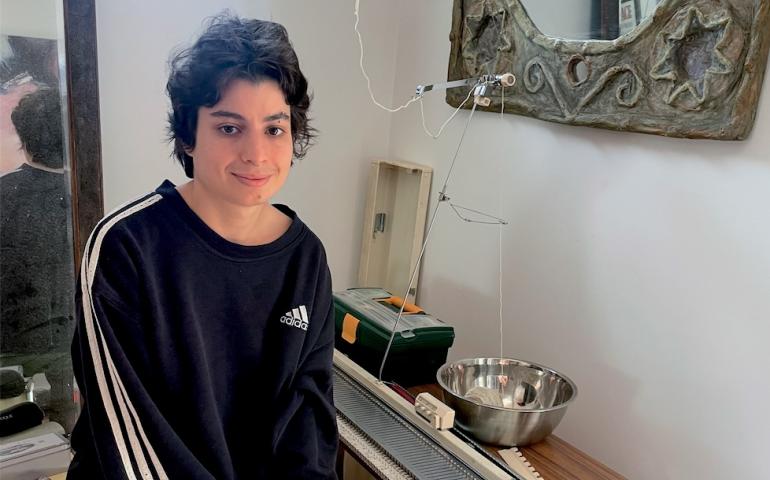
Kanae's Story
Kanae and her young daughter live in Boronia, a brand-new “affordable” housing unit block. Their rental home is a spacious two-bedroom apartment on the fourth floor with a large south-facing window overlooking the area. Living here would be a dream come true, especially since, unlike many other affordable housing properties that cost 74.9% of private market rent, Kanae’s rent is set at 35% of her income, making it closer to being actually affordable, but it is no dream after all.
As soon as summer comes, Kanae’s brand-new unit turns into a heat box. To better understand the temperature changes in her home, earlier in the year, Kanae bought a thermometer that recorded heat every 15 minutes over 76 monitored days between January and May. During that period, the apartment reached or exceeded 27°C on 41 days and 28°C on 19 days. The highest temperature recorded by the continuous Wi-Fi thermometer was 29.9°C. Importantly, Kanae reports that on 21 monitored days, even the minimum temperature remained at or above 25°C, meaning there were repeated periods when the apartment did not cool sufficiently overnight. On one particularly hot January day, Kanae’s daughter’s bedroom reached 34°C while the living area got to a scorching 35°C.
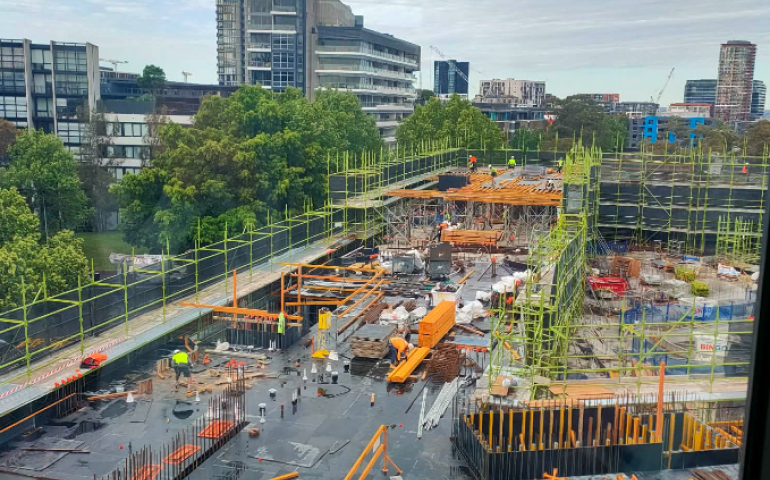
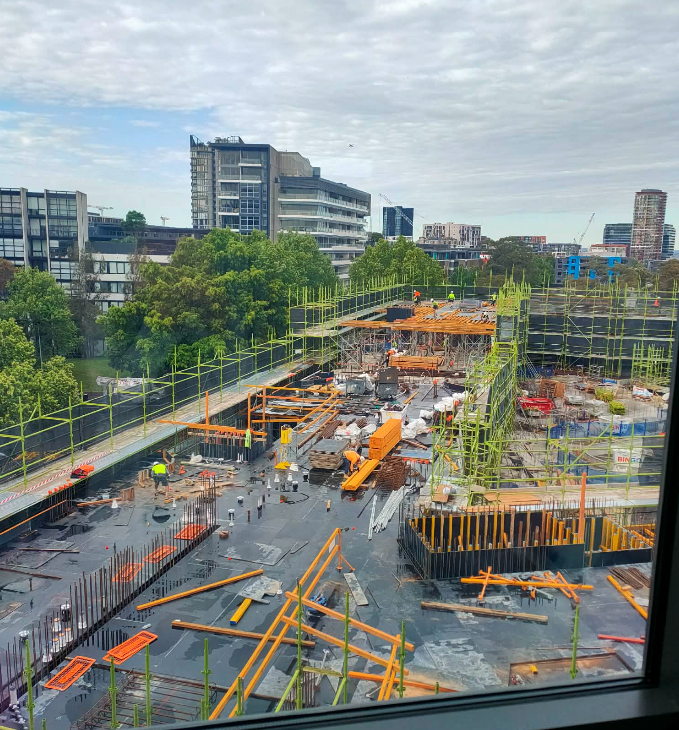
The flat does not have fixed air conditioning and, according to City West Housing, the apartment was not designed with provision for the future installation of a fixed air-conditioning system. Opening the windows isn’t possible for most of the day because the building is sandwiched between two building sites. The construction outside is no temporary inconvenience either; Kanae was informed that one of the building sites will be active for the next 5 to 10 years.
When she contacted her landlord, City West Housing (CWH), about the unsafe indoor temperature, Kanae was told the company didn’t expect the apartments to heat up and suggested she open the windows to ventilate the space. Perplexed by the response, Kanae escalated her complaint. Since then, CWH has formally acknowledged that the Boronia apartments rely on cross-ventilation and fans for cooling and conceded that the noise and dust from the surrounding construction limit Kanae’s ability to open doors and windows and obtain airflow. In addition, the housing provider offered to pay $300 toward a portable air conditioner for her apartment. While the use of a portable air conditioner may provide some respite from the heat, Kanae has not yet accepted the offer. She says many variables still need to be considered.
A portable unit requires an exhaust arrangement through a window. However, there are issues with the window configuration, flyscreens, construction dust, accessibility and safety. This is particularly important because my daughter is blind, so maintaining a safe window environment is very important in our home. I also have concerns about portable air conditioning as a long-term solution from the perspective of electricity costs and energy efficiency.
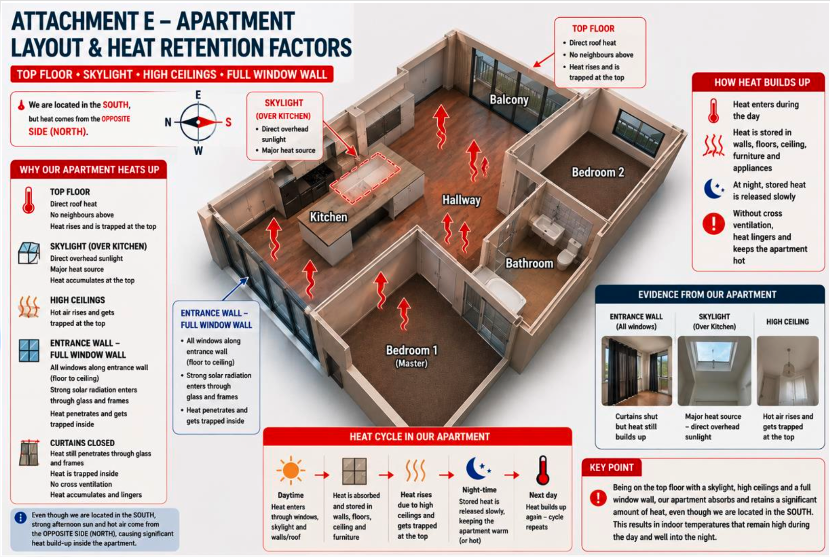
Since the first hot summer, City West Housing has made an effort to reduce heat stress for its residents by installing ceiling fans. It has also agreed to install motorised blinds to reduce heat entering through the high-level skylights, and the process of arranging their installation is currently underway. Kanae welcomes these measures.
However, she remains unclear how and why a new affordable housing development like Boronia can rely so heavily on natural cross-ventilation without a practical long-term alternative cooling solution. Especially given the extensive surrounding construction, which was already anticipated before residents moved in.
City West Housing's formal explanation states that only a small number of apartments at Boronia were designed with air conditioning, primarily west-facing apartments. The provider says that the necessary infrastructure was incorporated into those apartments during the original building design, while apartments that were not designed for air conditioning do not have provision for future installation. The assumption behind these design decisions, as Kanae was informed, was that apartments with other orientations would not experience the same level of heat and therefore did not require air conditioning.
Further to that, City West Housing has proposed considering placing Kanae on a transfer list for an air-conditioned two-bedroom apartment within Boronia if one becomes available. However, there is no guarantee as to when such an apartment might become available.
As she prepares to take her housing matter beyond CWHs’ internal appeals processes and to the Housing Appeals Committee (HAC), she intends to bring poignant questions for the members to consider:
If natural ventilation cannot adequately address the problem in the real living environment, and portable air conditioning is not a safe, practical and effective long-term way of cooling the whole apartment, then what will actually solve the heat problem in this apartment?
Kanae is a passionate advocate for accessibility and inclusion - in her role as a member of Waverley Council's Access and Inclusion Advisory Panel and as a mother of a blind child.
Her concerns about living at Boronia extend beyond excessive heat. She has also repeatedly raised concerns about the lack of effective building management, adequate cleaning and maintenance, and appropriate security in the residents' shared spaces.
For me, these issues are accessibility issues. My daughter is blind, so maintaining clean, safe, predictable and unobstructed common areas is particularly important. Something left on a floor or in a circulation area that another resident may simply see and walk around can present a very different risk for someone who cannot visually identify the obstacle or hazard.
To me, these concerns also raise a broader question about what “affordable housing” should mean in practice. Affordability is extremely important, but a home also needs to provide a living environment that is safe, hygienic, accessible and practically liveable.
Kanae has no intention of giving up on her and her daughter’s right to a safe and comfortable living environment.
I'm not simply asking for air conditioning because I want it. I have lived through the first summer in this apartment, monitored the temperatures and considered the alternatives. Based on the reality of living here, I believe fixed split-system air conditioning is the most realistic long-term solution.
If new social and affordable housing is promoted as sustainable, that sustainability needs to work in practice for the people who actually live there. If passive design and natural ventilation cannot maintain a safe and reasonable indoor temperature in real-world conditions, there needs to be an effective, safe, affordable and accessible cooling solution.